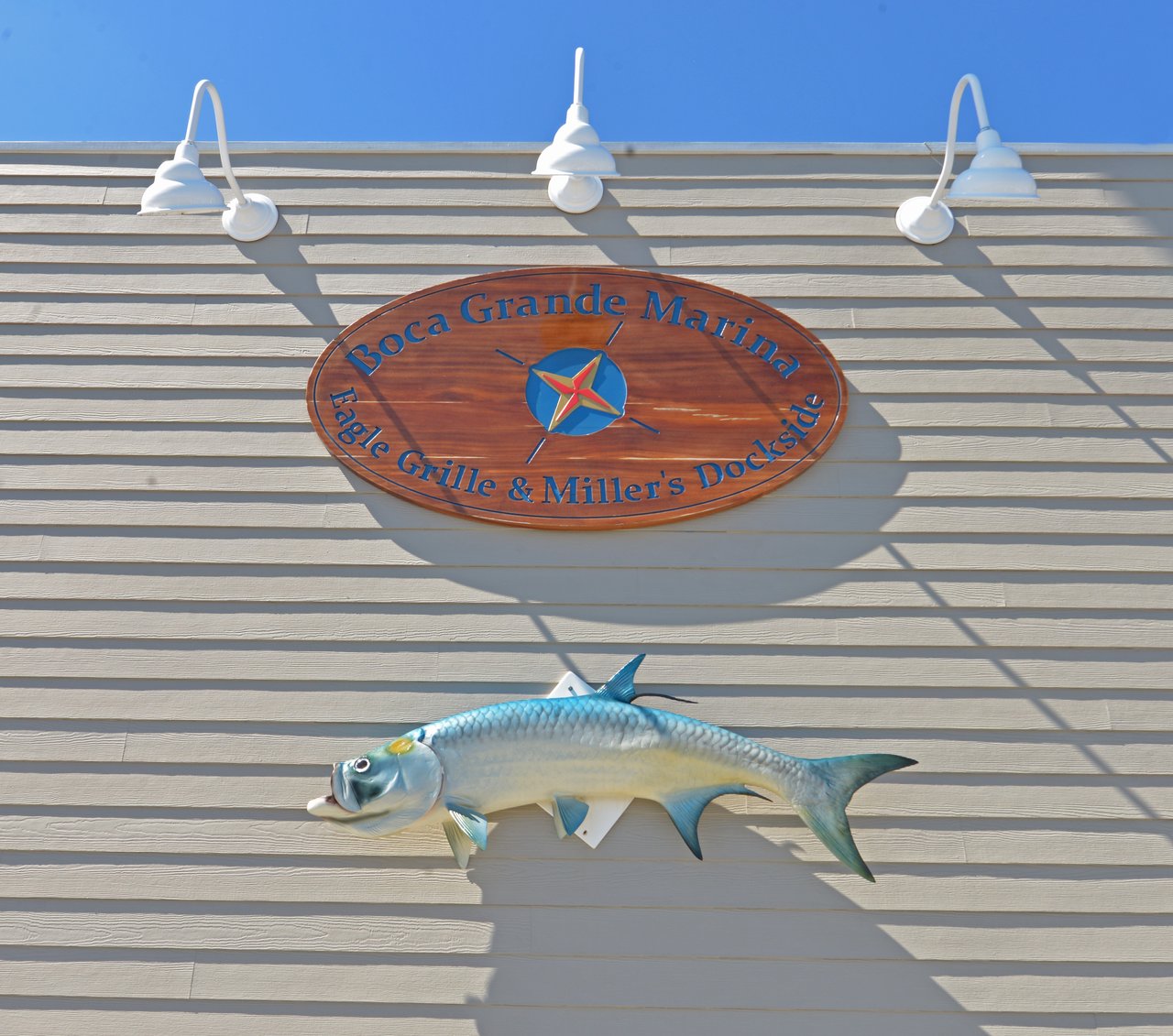
Monday afternoon at Miller's Dockside looked the way it always does on a holiday: golf carts stacked three deep along Harbor Drive, a Hawaiian shirt or two among the regulars, and a line for the bar that didn't clear until well past two. Bridgette Winger's Labor Day Luau ran from 11:30 a.m. to 4 p.m., and the invitation carried its own quiet warning for anyone who reads between the lines of a marina restaurant's calendar: grab a bite or a drink to last you until October. That's not a slogan. It's a scheduling reality for a restaurant that runs on the rhythm of the boats tied up outside it.
Two hundred yards inland, on the canals that give Harbor Drive Waterways its name, the water stayed almost still.
That contrast is not an accident of timing. It's a structural fact about this subdivision that most people who don't live here would never think to ask about, and it explains something residents feel every single holiday weekend without necessarily naming it: why the busiest boating days on the island barely touch the canals themselves.
A Holiday Weekend Built for Boat Traffic
Labor Day weekend arrived with the usual regional buildup. The South Gulf Cove Lock, which regulates boat traffic well north of the island, extended its operating hours to 9 p.m. from Friday, September 4 through Monday, September 7, specifically to handle the holiday surge before returning to its normal 7 a.m. to 7 p.m. schedule on September 8. Over that same span, the U.S. Coast Guard, the Coast Guard Auxiliary, Florida Fish and Wildlife, and local maritime security ran Operation Dry Water, a multi-agency patrol effort aimed at pulling impaired operators off the water during the weekend when boat traffic peaks hardest.
Both of those facts point to the same thing: a lot of boats moving through a lot of water in a short window. Charlotte Harbor, the Intracoastal Waterway, and the channel leading into Boca Grande Marina all saw the kind of traffic that justifies extended lock hours and extra patrol boats.
Boca Grande Marina itself, the property still known locally by its old name of Miller's Marina, sits right at the mouth of that traffic at 220 Harbor Drive. It's built to absorb exactly this kind of weekend. The marina's approach and dockside depths run about 6.5 feet, and its slips are rated to handle vessels as large as 150 feet, which is why superyachts and serious sportfishers can tie up a short walk from Eagle Grille and Miller's Dockside without a second thought.
The Bridge That Decides Who Comes In
Harbor Drive Waterways sits directly behind that marina, and on paper it looks like an extension of the same waterfront. It isn't, not entirely. The subdivision was developed in 1969 as the first canal-front and dockage community built behind what was then Miller's Marina, and it still carries 83 platted lots, each fronting a canal or the boat basin along a concrete seawall.
The difference is what stands between those canals and the open water the marina sits on.
The interior canal system is crossed by a fixed bridge with roughly 13 feet of clearance at high tide.
That single number does more to shape daily life on these canals than any amenity list could. A 13-foot clearance is generous for a center console, a flats boat, or most cruisers running without a tall tower. It's a hard stop for a sailboat with its mast up, and it rules out a good portion of the larger flybridge yachts that can tie up at the marina just a few hundred yards away. The bridge isn't a gate with an attendant. It's concrete and steel, and it doesn't negotiate.
Boca Grande Marina (mouth of the channel) | Harbor Drive Waterways canals (behind the bridge) | |
|---|---|---|
Approach depth | About 6.5 feet | Interior canal, protected basin |
Vessel size | Up to 150 feet | Limited by 13-foot fixed bridge clearance |
Holiday traffic, Sept 5-7 | Extended lock hours, active Coast Guard patrols | Naturally filtered by bridge height |
That's the mechanism behind what residents already sense but rarely spell out. The loudest boating weekend of late summer happens at the marina, not on the canals it feeds. The water on Harbor Drive and Waterways Avenue stays calmer not because anyone is managing it that way, but because the infrastructure was built decades before anyone thought to plan for a Labor Day surge, and it happens to filter traffic by size rather than by intent.
What the Luau Actually Marks
The Luau at Miller's Dockside is worth sitting with for a second reason. It isn't framed as a season finale, but the wording around it treats the holiday as a hinge point. Grab something to last until October is the kind of line that only makes sense if the restaurant's own rhythm is about to slow down, which tracks with how the marina district works every year once the last of the summer holiday traffic clears out.
For anyone who lives along the canals, that shift matters more than it would for a visitor passing through. The walk or golf cart ride to Eagle Grille and Miller's Dockside is part of the daily texture of living in Harbor Drive Waterways, not an occasional treat. Knowing that the crowd thins out after the first week of September, and that the restaurant itself is signaling as much, is the kind of detail that only shows up if you're paying attention to a single Monday afternoon rather than a seasonal calendar pulled from a tourism site.
Streets That Do More Than One Job
Harbor Drive Waterways isn't purely a canal community tucked away from the rest of the village. Palm Avenue runs through it, the same Palm Avenue where the new Boca Grande Preschool building is currently under construction at 311 Palm Avenue, on property donated by the Pete and Ginny Nicholas family and zoned commercial, sitting behind the former 3rd Street Bistro site. That's not a detail about real estate value. It's a detail about what residents pass on an ordinary errand. A subdivision built around docks and seawalls also happens to share a street with a building project that will shape where island families drop off small children for years to come.
That overlap is easy to miss if you think of Harbor Drive Waterways only in terms of its water frontage. The canals define the property lines, but Palm Avenue defines a chunk of the daily foot and cart traffic, and right now that street is doing double duty as both a residential address and a construction zone for one of the more meaningful civic projects on the island this year.
Even the Turtles Kept Working Through the Holiday
One more marker of where September sits on the island's calendar: sea turtle nesting season hadn't wound down by Labor Day. The most recent weekly tally, reported September 2, showed Gasparilla Island State Park still counting 32 loggerhead nests and 489 hatchlings for the season, alongside far larger totals at Cayo Costa, 531 loggerhead nests and 20,879 hatchlings so far. Nesting season on this stretch of coast runs well past the last big holiday weekend of summer, which is one more reason the quieter water behind the Harbor Drive Waterways bridge matters beyond convenience. Less wake, less traffic, and a slower pace suit more than just the residents on the canal.
The Takeaway for Anyone Already Living Here
None of this changes what Harbor Drive Waterways is on paper: 83 platted lots on protected canals a short walk from the heart of the village, first laid out in 1969, still centered on the same marina that anchors the neighborhood today. What it does change is how you read a holiday weekend on this stretch of water. The surge belongs to the marina and the channel leading into it. The canals stay theirs, filtered by a bridge that was never built to manage traffic so much as it simply does, thirteen feet at a time.
If you're weighing what daily life actually looks like on these canals, from dock access to walking distance to the village core, Jamie Curry has spent years working these streets and can walk you through the specifics. Let's Connect.